
Yeki Bood, Yeki Nabood - The Origins of Persian Folktales
Updated: Aug 18
“Yeki bood, yeki nabood, zir-e gonbad-e kabood, gheyr az khoda hichkas nabood.”
There was one, there was no one, under the blue dome of the sky, there was no one but God.
Dating back to the medieval era of oral storytelling in Great Iran, this phrase originated in unwritten folktales passed generation to generation through grandmothers and marketplace storytellers. Long before it was written in print, the phrase was used in marketplace settings, and was a cue that could immediately quiet down an eager crowd, excitedly waiting to hear a juicy story. The phrase is a rhyming couplet in Persian, and was used to start each folktale in the oral storytelling culture of Iran, similar to how in English, the phrase, “Once Upon a Time”, is used at the beginning of fairytales. The Yeki Bood, Yeki Nabood phrase was especially powerful and could successfully capture the attention of listeners with its religious allusion, reminding believers that divine existence of god is eternal, while mortals have only a temporary, fleeting existence and insignificance on Earth.
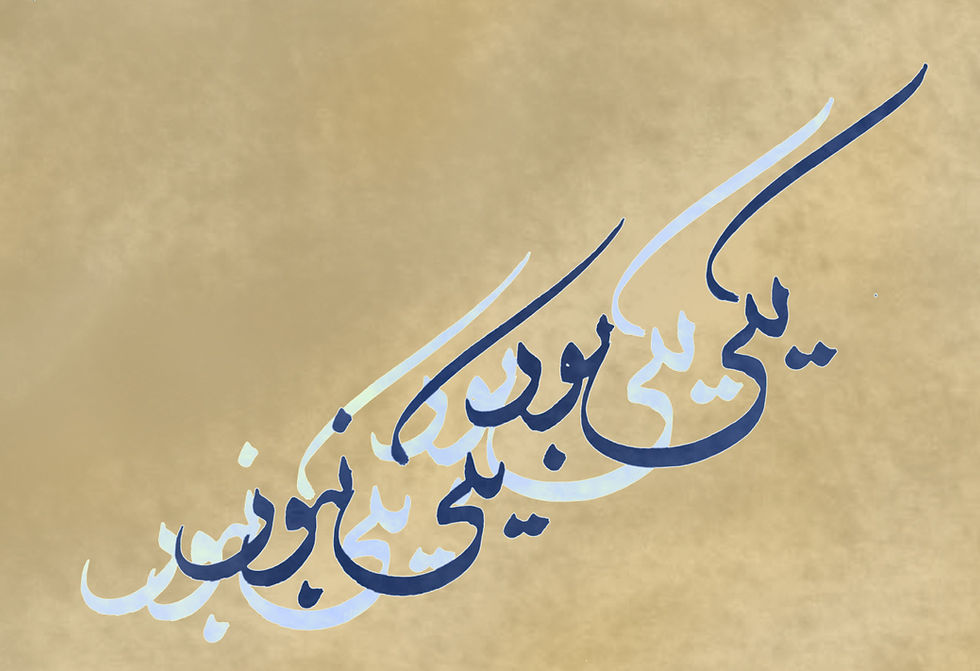
The phrase additionally acted as an attention hook, telling listeners to pay attention; “one was and one was not” is a vague and dreamy phrase, capable of diverting the listener from the real world, and sending them off to a realm of fairy tales. It tells the listener that the story to follow is not factually correct, yet it is correct in the sense that it contains deep human wisdom worth following. The expression gonbad-e kabood, (meaning blue dome), is a reference to the cosmos, widening the stage and putting the story on a universal level by alluding that the story is not just about a local village, but an important event that is witnessed by the universe.
While yeki bood, yeki nabood was originally used in small oral, circles, the phrase became formally recognized in 1921, when Iranian author Mohammad-Ali Jamalzadeh titled his political short story collection: Yeki Bud, Yeki Nabud, bridging formal prose with colloquial speak in his satirical stories criticizing the social, religious, and political backwardness of Iran in the early 20th century. Yeki bood, yeki nabood, despite its ancient origins, remains a cornerstone of Persian literature and culture today. Several modern artists use the phrase to comment on the duality of art pieces, scholars continue to analyze the underlying message of the poetic introduction, and musicians have repeatedly used the phrase as a song title to tell stories of heartbreak, existential longing, or love.


Comments